
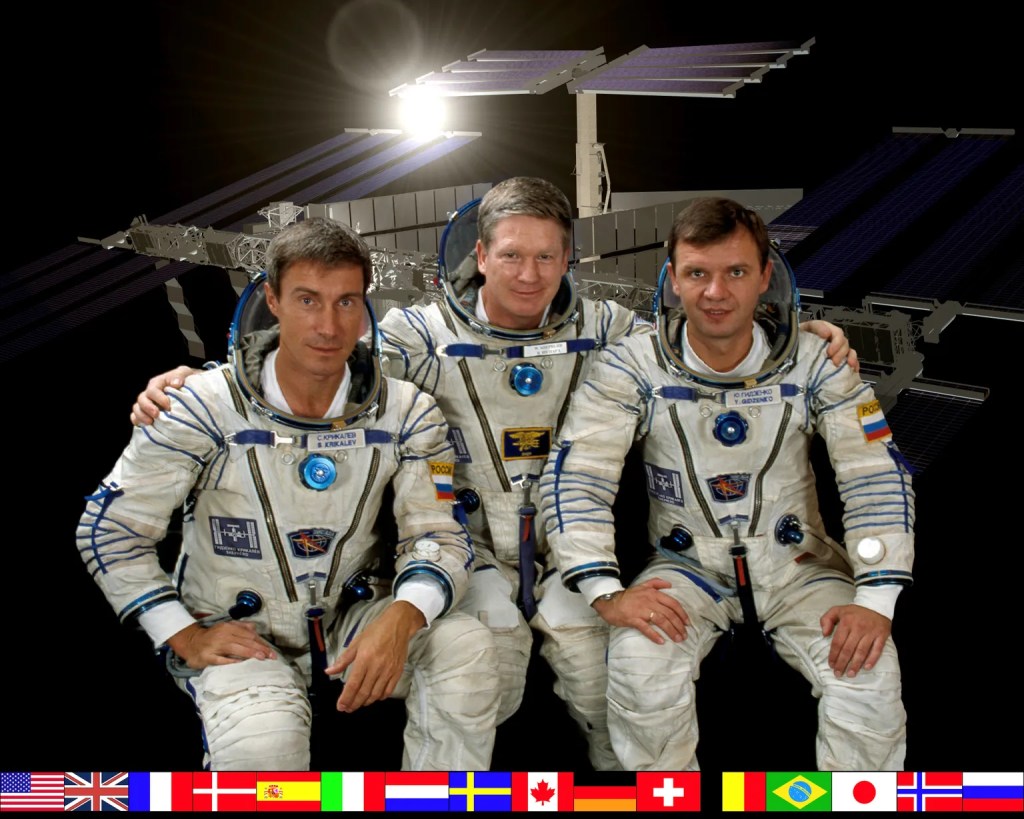
In November 2000, the first long-duration crew arrived at the International Space Station. Bill Shepherd, an American commander, and two Russian cosmonauts—flight engineer Sergei Krikalev and Yuri Gidzenko, commander of the Soyuz, the spacecraft that would dock with what was then still a work-in-progress—a floating symbol of what post–Cold War cooperation could look like.
The launch of the Expedition 1 crew occurred a week before the United States presidential election, so it got little attention in a country that had long been uninterested in space travel following Apollo 11’s inaugural moon landing in 1969. As Earth turned over from the 20th to the 21st century, the astronauts, American and Russian together, were laughing. They passed food between them—thermostabilized packets from the Americans, cans from the Russians—like it was the most natural thing in the world: Earthbound enemies suspended in zero gravity, passing rehydrated beef stew between them, as if it were nothing at all.
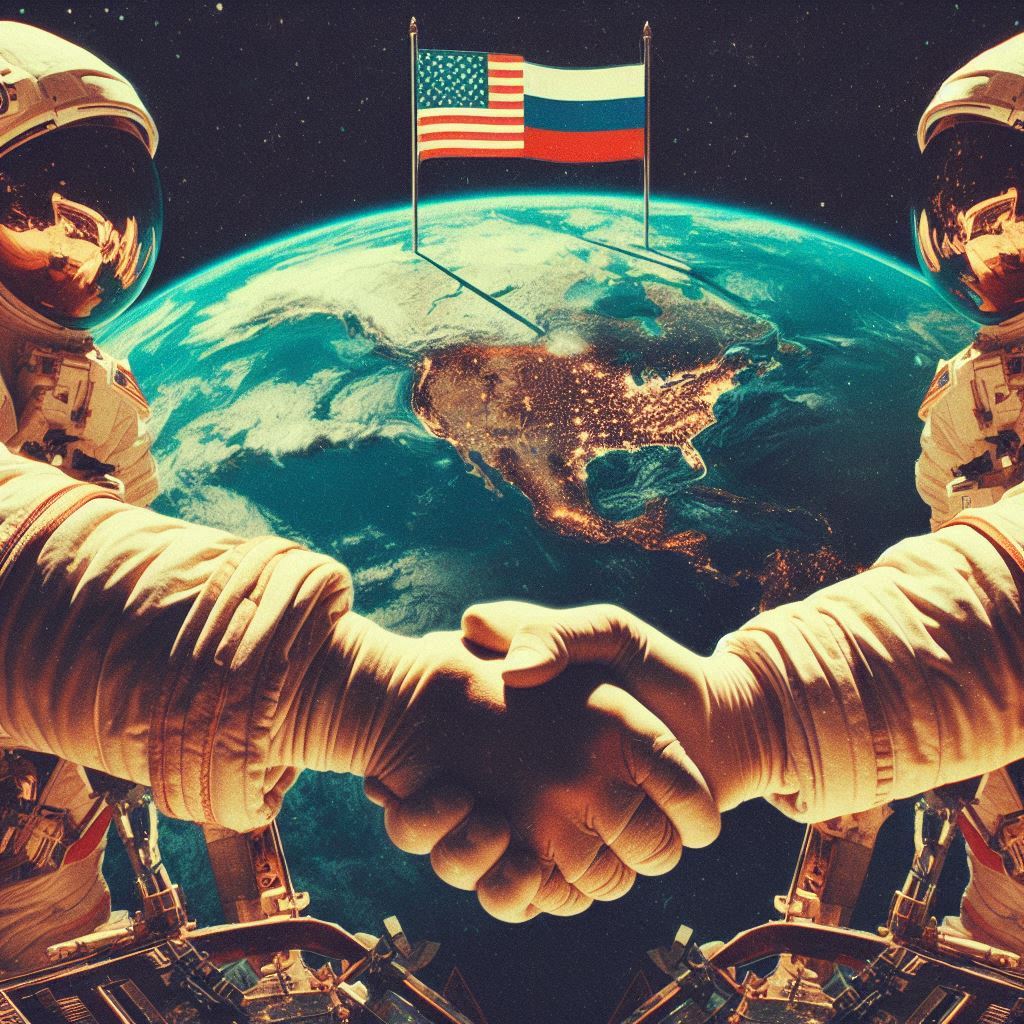
At the time, we were told this was the future: peace, cooperation, progress. The International Space Station wasn’t just a scientific endeavor—it was a gesture, a fragile handshake held across decades of suspicion and vacuous sky.
But, less than a year later, the twin towers would fall, and Vladimir Putin—already acting president and suspected by some as the mastermind of the 1999 apartment bombings in the Russian cities of Buynaksk, Moscow, and Volgodonsk, that were blamed on Chechen terrorists—would begin tightening his grip on Russia. The future that was supposed to begin in orbit began to dim. But for a moment, we believed. For a moment, we shook hands in zero gravity.
Before I ever understood what space really was, I watched 2001: A Space Odyssey. I was too young to grasp its plot, but I was mesmerized by its silence, its strangeness, its vastness. My father, born in 1950, came of age with the Mercury, Gemini, and Apollo programs and remembers the moon landing as a moment of pure awe. Though, it was my mother who told me something that really stayed with me: that the film’s depiction of American and Soviet scientists working together was, at the time, almost incomprehensible. Cooperation wasn’t the story we were told. Maybe that’s why I loved the film so much.
Later, I’d watch Apollo 13 on repeat until I could recite the lines from memory. Something about the combination of disaster, ingenuity, and quiet collaboration gripped me. And growing up in a mixed household full of inherited ambivalence toward Russia, I found myself fascinated by its history. I had picture books about imperial princesses and ballet legends like the Nijinsky siblings, who were technically Polish but always shelved under Russian greatness. At nine, I watched all seven hours of the Soviet War and Peace on grainy VHS, courtesy of our upstairs neighbor from Białystok. By the time I moved to Brighton Beach as an adult, the Russian language was already familiar to my ears. It felt like part of the background music of my life.
My mother and sister spent their early years in Communist Poland. My mother’s stories from that time flickered between drudgery and grandeur—ration lines one minute, impromptu trips to the Black Sea the next. I’m not sure if this really happened, but I remember her telling me she visited Crimea once, back when it was just another stop in the vast, fraying tapestry of the USSR.
Those stories stayed with me. I grew up with inherited suspicion—my Polish Catholic mother’s disdain for Soviet control, my Ukrainian-Jewish grandmother’s grief for a familial homeland that kept changing names, borders, and loyalties. And yet, I was always drawn to Russia’s scale, its ghosts, its contradictions. I read about the Romanovs and the Bolshoi. I wanted to experience the white nights, the Mariinsky, the Hermitage.
The International Space Station was never supposed to work—not in the literal sense, but in the geopolitical one. Built in pieces, launched across decades, and held together by bolts, code, and diplomatic tape, it was the improbable child of Cold War rivals who had once raced to the Moon with clenched fists. NASA and Roscosmos led the partnership, but Europe, Canada, and Japan also contributed crucial modules, technology, and crew. It was a patchwork not just of hardware, but of philosophies. For years, it worked. For years, it floated above the mess we made of things down here.
The first real fracture came early. In February 2003, the space shuttle Columbia disintegrated on re-entry, killing all seven astronauts aboard including Ilan Ramon, payload specialist and the first Israeli in space.

The tragedy rippled quietly through the program—no explosions, no thunder, just a slow unraveling of confidence. Flights paused for over two years. The shuttle program limped along until its retirement in 2011, ending not just an era of American spaceflight, but the illusion that the U.S. could reach the stars on its own.
After Columbia, every American astronaut en route to the ISS had to ride in a Russian Soyuz capsule, launched from the Baikonur Cosmodrome in Kazakhstan. It was an ironic dependence—Cold War rivals now relying on each other to keep a shared dream alive. NASA paid Roscosmos tens of millions per seat.
Soyuz (Союз) means “union” in Russian.
And for a while, it was.
There were delays. Language barriers. Political tensions. Budget fights. But the station stayed occupied. The trust held. In orbit, American beverage pouches floated next to Russian canned goods. Translations happened midair.
What should have been a vulnerability became a strange kind of strength. The United States and Russia had to keep talking. Had to keep trusting. There’s no solo option in orbit. On board, there was protocol, but also a quiet intimacy—shared meals, joint repairs, music, jokes. Americans drank Russian tea. Russians used NASA equipment.
As the station quietly orbited above, Earth’s priorities shifted. The U.S. turned space travel over to billionaires. Blue Origin and Virgin Galactic promised joyrides for the ultra-rich. Exploration in the name of science gave way to spectacle.
Russia turned inward, too. In 2014, it annexed Crimea. Sanctions followed. Diplomacy shriveled. Yet American astronauts still boarded Soyuz capsules. Russian cosmonauts still floated beside them in orbit. The cracks widened, but the station held—for a while.
The irony was striking: countries that could no longer share a diplomatic table were still brushing their teeth together in microgravity.
It became harder to explain, even as it became more essential. In an era of slogans and strongmen, the ISS was a relic of nuance: a space that required mutual trust, translation, and presence. There was no spin room in orbit. Just recycled air and shared responsibility.
Things began to shift more rapidly. In May 2020, SpaceX launched its first crewed Dragon 2 flight, marking the return of human spaceflight from U.S. soil—and the beginning of a new era.
The reliance on Soyuz faded, but the fragility of the partnership remained. Roscosmos issued symbolic threats to cut ties, then reversed course. Diplomats bickered. Strongmen postured. Still, the station endured—crewed, humming, quietly miraculous.
The irony was inescapable: countries that could no longer sit at the same diplomatic table were still brushing teeth together in microgravity. Still trading language lessons. Still trusting each other with the air they breathed.
In 2022, Russia invaded Ukraine. The last illusion of post–Cold War diplomacy shattered. Not long after, NASA confirmed plans to decommission the International Space Station by the end of the decade. There would be no multinational successor—no shared orbiting lab, no continuation of that fragile alliance. Just private stations, corporate payloads, and a new Cold War chill.
Russia threatened to withdraw from the ISS by 2024, then backtracked, then contradicted itself again. The choreography of cooperation became clumsy—almost dangerous. Trust wore thin.
Still, astronauts and cosmonauts floated side by side, growing lettuce in zero gravity while their governments postured on the ground below.
Most recently, two NASA astronauts—Barry “Butch” Wilmore and Sunita Williams—were stranded on the station for months after a routine mission was extended due to technical issues. The mission was only supposed to last eight days. NASA couldn’t bring them home. SpaceX had to step in.
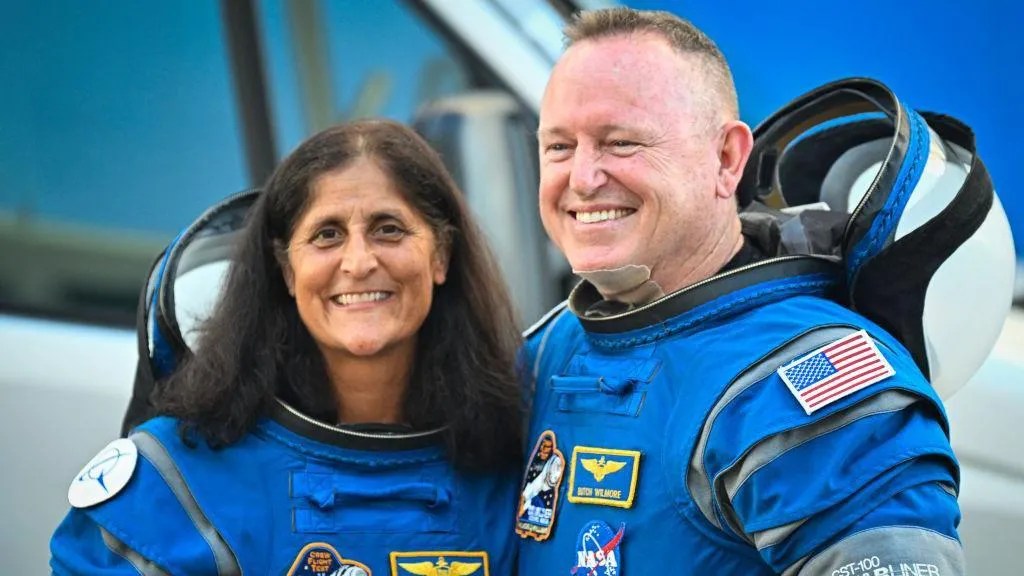
The irony was sharp: the most powerful country on Earth, unable to retrieve its own crew from a station it helped build.
The International Space Station was a relic of a brief, flickering hope—when cooperation wasn’t just a dream, but an orbit. It never made headlines the way invasions or elections did. It just stayed up there, turning silently, asking us to believe in something bigger than flags.
Now that hope is dimming—not with fire or spectacle, but with the quiet dismantling of something too fragile to sustain. One module at a time. One silence at a time.
 factorycandy