
Sexual Politics, Female Agency, and the Moral Framework of The Handmaid’s Tale
“Boy, look at these outfits…it’s a parade of sluts.”
That’s how Aunt Lydia snarls her assessment of the world before Gilead—an era of sexual freedom, pants, dating apps, and bad decisions. In her eyes, the collapse of the former United States was inevitable. A society built on female autonomy was too much for her to stomach. It was bound, she believes, to unravel.
And yet, when you watch The Handmaid’s Tale—not just read it, but see it in its contemporary iteration—it becomes clear that what Lydia (Ann Dowd) calls chaos is really freedom in disguise. Freedom to love badly. Freedom to grieve, to fuck, to run, to refuse. Freedom to choose, even when those choices are messy, shameful, or simply “incorrect.”
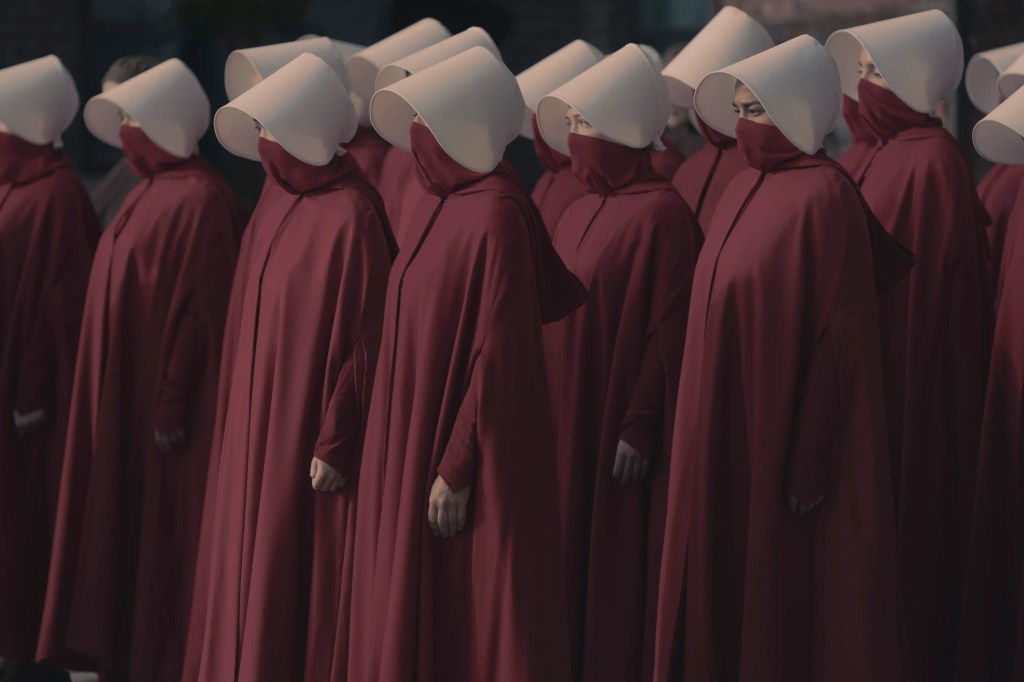
Hulu’s adaptation doesn’t just dramatize a dystopian future—it reflects, refracts, and confronts the moral panic of the present. In its brutal choreography of scarlet robes and white bonnets, it shows us what happens when protection becomes control, when “freedom from” is used to erase “freedom to.”
Lydia isn’t just a character—she’s a mouthpiece for a worldview that sees freedom as chaos, and women’s bodies as the battleground.
In this scene where she delivers this “parade of sluts” line (season 1, episode 10), a group of young women, including June Osborne (portrayed by Elisabeth Moss), are marched through the Red Center—a repurposed gymnasium turned indoctrination facility where fertile women are “trained” to become Handmaids. It is here that they are taught to accept their assigned role in Gilead’s monthly ritual of state-sanctioned rape known as The Ceremony. In this ritual, the Commander has sex with the Handmaid while she lies between the knees of his barren wife, whose hands rest on hers as a symbolic gesture of ownership and compliance.
Gilead has, with the exception of Alaska and Hawaii, replaced the United States of America. Fertile women are whittled down to their uteruses. Their identities erased, their names stripped. Their bodies—functionally desecrated—are rendered public property.
Lydia refers to them always as “girls,” never “women.” Her power comes from belittling theirs. And in that same scene, she preaches to them: “Humble yourself in the eyes of the Lord, and He shall lift you up.” How do they humble themselves? By disappearing. Hands clasped. Eyes down. Even in forced service to this new world order, sexually active women must hang their heads in shame.
This is where Lydia’s fatal miscalculation begins. She believes modesty can erase memory. That shame can erase longing. That rebranding women as vessels will unwrite their history. But even in this forced new order, the truth seeps through: sex is still happening. Desire still hums beneath the ritual. And everyone—Commanders, Wives, Handmaids—knows it.
Let’s be honest: Gilead cloaks the Ceremony in Biblical reverence, but it’s a pageant of control. The sex is stiff, quiet, choreographed—designed to be clinical. There’s supposed to be minimal touching, no intimacy. It’s meant to look like healing. But it is, by all measures, state-sanctioned rape. A performance for the benefit of power.
And yet, even in this cold and calculated setting, the lines blur. Commanders bend the rules. Wives develop resentments. Handmaids—particularly the younger ones—are still viewed through a lens of temptation. Which brings us back to something obvious that too many pretend isn’t true: humans gonna human. They want. They deviate. They make up stories to justify the gap between what they’re told to want and what they actually crave.
People—not just men, and I cannot emphasize that enough—will use almost any excuse to justify their desire to color outside the lines. Rather than own up to non-monogamy, sexual need, or the hunger to imprint on more than one life, they build myths. Rituals. Ideologies. Sometimes entire nation-states.
Gilead wasn’t born of perversion. It was born of denial—denial of messiness, of ambiguity, of the very human impulse to want what you’re told you shouldn’t. Most people don’t want absolute power. They want permission. They want the illusion of righteousness wrapped around their hungers.
And honestly? I get it. Human beings are kind of gross. I’m gross too. But I’d rather name it than pretend it’s virtue.
We see this need for control masquerading as righteousness most clearly in the men of Gilead—particularly in Commander Waterford and later with Commanders Blaine and Wharton.
In season two, we see Nick Blaine (Max Minghella) get assigned a teenage wife. She is quiet, compliant, pious, and visibly nervous. This isn’t courtship. It’s state-sponsored grooming at best. And no one flinches, except for June. Because in Gilead, ritual is how they normalize the unthinkable.
The girl is later executed by drowning for having an affair (with a young man closer to her age) after Blaine neglects her. And he does neglect her, because he is not, in every horrifying sense, a pedophile. He doesn’t abuse her. But he doesn’t protect her either.
Commander Putnam (Stephen Kunken), too, takes his pubescent Handmaid as a mistress, only to ultimately be executed for apostasy, as he raped the young girl before she was officially assigned to him, a stark violation of Gilead law.
And then of course, there is Commander Waterford (played by Joseph Fiennes), Serena Joy’s first husband. Waterford is a rapist. A hypocrite. A pompous ass. A pervert. A founder of Gilead and a leader in its government, he is directly responsible for the suffering and deaths of thousands, at least. His eventual fate suits him. He is eventually executed via beating and then hanged, but not before spending years benefiting from the very system he helped construct. He’s beaten to death and hanged by a horde of women whose lives his ideology attempted to destroy—destiny catching up to cruelty after years of impunity.
Then, finally, in the final season, Commander Wharton (Josh Charles) marries Serena Joy (Yvonne Strahovski) in a lavish, unsettling ceremony, only to receive a Handmaid as a “gift” that same night. It’s positioned as practical—about fertility, about duty—but the reality is far more sinister. When Serena protests, trying to humanize the girl and pleading with Wharton that she herself is fertile, he looks her in the eyes and says, “But you’re only one person, my love.” And there it is. The quiet confession. The truth beneath the system. This isn’t about building big families. It’s about leaving a mark on multiple women. It’s about indulgence under the guise of order.
Not every woman in Gilead is raped. But that does not mean they’re free.
The system has its own form of punishment for women it doesn’t want to fuck: it makes them invisible. If some women are over-sexualized in Gilead, others are erased altogether.
Marthas are the domestic class—women too old, infertile, or noncompliant to bear children. They cook. They clean. They keep the household running in silence. They wear drab olive and speak in whispers. There is no ritual to their existence. No protection. No recognition. Marthas compete with Handmaids to represent the worst of the chattel slavery that defines Gilead.
EconoWives are allowed to live with their husbands—if you can call it living. They wear grey. They do everything and get nothing. They raise children if they can, labor if they must, but they are seen as second-class even by other women. They are barely acknowledged by the state.
And then there are the women in the Colonies—exiled to dig through toxic waste, stripped of purpose, future, or identity. Gilead doesn’t execute them, but it doesn’t let them live either. It rebrands slow death as spiritual grace.
These women are not seen as sexual. They are not even seen as dangerous. They are simply erased. And in Gilead, that’s supposed to be a mercy.
But not every woman is erased. Some are repurposed.
Enter Jezebels—Gilead’s underground brothel, reserved for powerful men and visiting diplomats. It’s where “fallen” women—rebels, queers, former professionals and several former Handmaids—are given a second chance… if you can call it that. Their lives are spared, but their bodies become a playground.
The hypocrisy is brutal. Jezebels is the physical manifestation of Gilead’s central lie: that it values purity. It doesn’t. It values control. These women are dressed up in cocktail dresses and lingerie, forced to perform sexual servitude in secret while the regime praises chastity in public. It’s a system that punishes visibility while quietly indulging in everything it condemns.
Moira, June’s best friend (played by Samira Wiley), ends up here after escaping the Red Center early in the story. Her survival comes at the cost of her freedom. Her slow walk through that mirrored hallway—wrapped in silk, neon, and danger—is one of the series’ most chilling visuals. She’s not protected. She’s not empowered. She’s tolerated, because she’s useful. Because her body can still serve a purpose.
Jezebels isn’t a loophole. It’s a mirror. A funhouse reflection of every system that pretends to protect women while exploiting their bodies behind closed doors.
If Jezebels is where Gilead hides its appetites, then Janine is where it reveals its cruelty.
Janine (Madeline Brewer) is often treated as a form of dark comic relief—flighty, overemotional, naïve. But her story is one of the most brutal in the entire series. Lydia has one of her eyes taken out early on for resisting. She is raped, repeatedly, under the guise of The Ceremony. She becomes pregnant, gives birth, and then watches her child be taken from her and renamed. She tries to end her life. She survives. And somehow, she remains tender—an impossible softness in a world that rewards only silence and steel.
She is everything Gilead hates: vulnerable, loving, defiantly alive.
Commander Lawrence (Bradley Whitford), who first shelters June as his Handmaid, is one of the few men in Gilead who shows sincere glimpses of guilt. He refuses to perform the Ceremony with June—less so out of virtue, more so out of discomfort and a simple lack of desire to do so. He is only forced to comply when a state doctor comes to literally check that he ejaculated. It’s one of the most viscerally humiliating scenes in the series—for everyone involved. Even his resistance is bureaucratized. The trauma of witnessing the ordeal ultimately drives Lawrence’s wife to madness.
Later, Lawrence arranges for Janine to be sent to Jezebels after his new wife, Naomi (formerly Naomi Putnam) refuses to have her in the home. Naomi’s daughter is in fact Janine’s—she is Angela to Gilead, Charlotte to Janine. It’s a grotesque act of protection. A trade-off. A life spared, but at what cost? Lawrence doesn’t save Janine. He simply chooses the less immediate cruelty. And in Gilead, sometimes that’s the closest thing to mercy anyone gets.
Throughout the series, June is trapped between two men: Luke (O-T Fagbenle), the man she loves from before, and the aforementioned Nick, the man she loves in captivity. Neither can save her. Neither fully understands her. And yet, their existence in her orbit is a reminder that even in systems built to erase choice, desire still flickers. June’s agency is constrained, but never extinguished—not emotionally, intellectually, or sexually.
Toward the end of the series, June gives a monologue that cracked something open in me. I’ve lived long enough to know what it feels like to be both too much and not enough. To be wanted and discarded. To be told silence is safety. That’s why June’s voice matters so much. She speaks—not with sorrow, but with fire—about the women whose voices have been taken.
“…we’re not fallen women,” she says.
“We’re rising up because, in each and every one of us, is this immaculate soul that was given to us by God that’s just crying out for dignity and freedom.”
Not just survival. Not protection. Dignity. Freedom.
The things we’re told we don’t deserve unless we behave properly. Unless we play the part.
But June doesn’t behave, despite her early efforts. She defies. She resists. She chooses—over and over again—herself, her daughters, her rage, her complexity. She is not pure. She is not polite. And that’s precisely what makes her powerful.
Which brings me back to that line, that insult Lydia flung like scripture: “a parade of sluts.”
Maybe that’s what we are.
Women who refuse to be simple.
Women who choose desire, even when it makes us look bad.
Women who make mistakes, then get up and make more.
Women who want to be touched—and left alone
Women who want to own our bodies—even when we’re still figuring out how.
Gilead fears sluts not because they’re dirty—but because they’re free. And so do a lot of people, honestly.
But I’ll take a parade of sluts over an army of sanctimonious zealots any day.
Originally published via Gigi After Hours on Substack (May 16, 2025).
Let me know what you think—DMs are open, comments welcome, or find me over at Gigi After Hours for more like this.





















 factorycandy