Two amazing legends, Chuck Berry and Jimmy Breslin, passed away this weekend.
As both a lover of rock ‘n’ roll and an aspiring journalist of sorts, the deaths of these two men have had a significant effect on me.
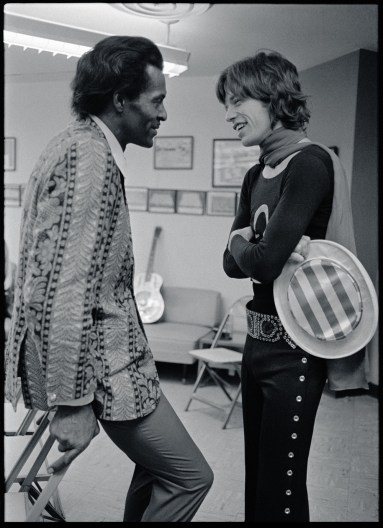
The first Chuck Berry song I ever listened to was “School Days.” It was neither his best song, nor his most famous, but I was hooked on his sound immediately. Over twenty years later, I continue to listen to his music on a regular basis. His influence is profoundly apparent in the music of many other artists, particularly the Rolling Stones, who featured multiple Berry covers on their debut album.
Chuck Berry and Mick Jagger, 1969. Photo Credit: Ethan Russell
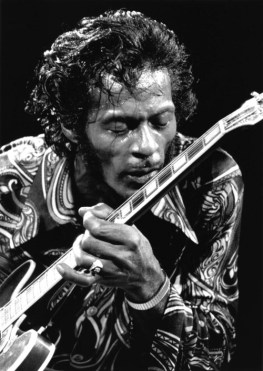
When I was about ten years old, I saw a cartoon version of Chuck Berry in a magazine (I think it may have been Entertainment Weekly, but I could be mistaken). The image of this man in a spiffy suit, riffing on his guitar and literally bouncing off the walls, drew me in immediately. I became, and remain, fascinated with the Father of Rock ‘n’ Roll.
Chuck Berry in performance in New York City, 1971. Photo Credit: Bob Gruen
The one thing that Chuck Berry and Jimmy Breslin had in common is that they were both pioneers within their respective fields.
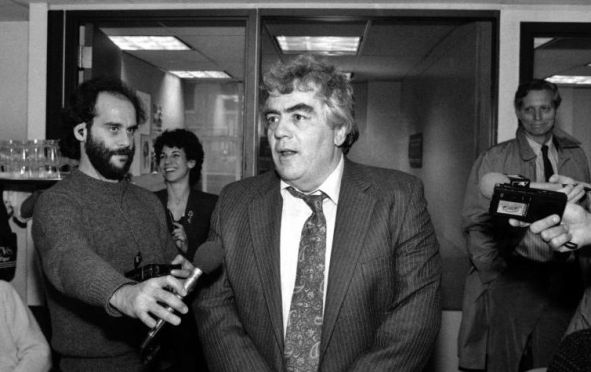
Jimmy Breslin was an journalist, author, and newspaper columnist from Queens, and his unique perspective on the working-class of New York City earned him a Pulitzer Prize. He also wrote several very good books, including How the Good Guys Finally Won, which is about the Watergate scandal.
Jimmy Breslin speaks to reporters in the New York Daily News newsroom in Manhattan on April 17, 1986 after winning the Pulitzer Prize. Photo Credit: Mario Cabrera/Associated Press
I actually have A LOT to say about Jimmy Breslin and his legacy, but I am afraid I don’t have the energy to get into it tonight. I am making a point to post something every day though, and I already working on a longer piece about this groundbreaking character.
In the meantime, check out this interesting article about Breslin’s commentaries on Donald Trump. It’s a good read.
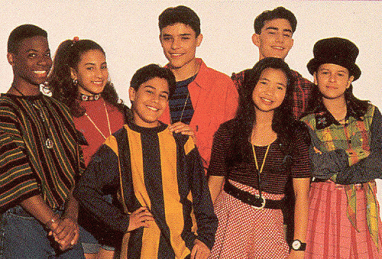
In the afternoon hours of October 4, 1992, a new children’s program premiered on PBS. The series was designed to teach reading and writing skills to elementary and middle-schoolers, but for me (the child of an English teacher and an editorial proofreader), its impact had nothing to do with improving my grammar. What struck me from the very beginning was that it depicted kids like me (albeit several years older than I was), living in my city, in a neighborhood just a few miles from my own.
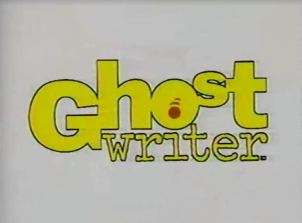
The name of this television program was Ghostwriter.
There are many things to potentially write about in reference to Ghostwriter: its well-crafted mysteries, its enduring educational value, its eponymous “ghost” which was really just a weird ball of light rendered by cheap, ’90s CGI… But I’m not interested in discussing any of those.
Ghostwriter is generally considered one of the most diverse children’s programs in television history. It didn’t focus on issues of race or social status, but it didn’t avoid them either. It was a complex show that possessed a remarkable verisimilitude that is as exceptionally rare today as it was back then, almost 25 years ago.
Those fashions… (puke)
Images of the upper crust of American society have dominated our television screens since the early 1980s. The soapy sob stories of shows like Dynasty and Beverly Hills, 90210 were attractive, sensational, and easy to digest. Their realities were always picturesque and promising, even at moments when characters were placed in the most perilous scenarios. Simply put, they were pretty.
Ghostwriter was a children’s show through and through, but it was never pretty. It was very atmospheric, and the backdrop of a raw, unembellished New York City often seemed to function as a character in and of itself. There was an underlying layer of social commentary that presented itself visually, rather than through spoken dialogue. The streets were strewn with garbage and the junior high school seemed to get vandalized regularly, but those were not problems that needed to be tackled onscreen. That was just reality, and it was the reality that I grew up in as well. The characters on Ghostwriter were like me: poor latchkey kids, roaming the streets of a pre-gentrification Brooklyn.
Deciding whether to enter the shady garage…
The homeless man on the corner has gone missing
Vandalism strikes the school yet again
Ghostwriter was set in the neighborhood of Fort Greene, and was unique in that it was shot on location. Many of the show’s settings were concentrated around the thoroughfare of Myrtle Avenue, which back then was known to us locals as “Murder Avenue.” To shoot a children’s program, or any production really, in that area, was atypical at the time.
It may seem strange, but although Ghostwriter was a harmless kid’s show, I have a difficult time watching it because it hits a bit too close to home. I can’t seem to sit through an episode without flashing back to my tender years, which were spent living in a housing project in a far corner of Brooklyn, attending a crappy, underfunded public school, and being the youngest member in a volatile household that often relied on food stamps. Unlike many other “millennials,” I do not have nostalgia for my childhood.
The PJs (not unlike where I spent my early childhood)
The PJs (not unlike where I spent my early childhood)
The PJs (not unlike where I spent my early childhood)
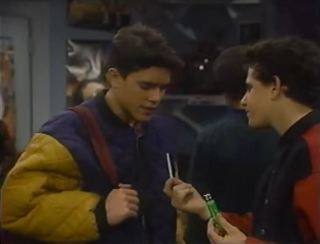
Personal crap aside, Ghostwriter is a great go-to if you’re ever searching for an unvarnished, but accessible, portrayal of Brooklyn in the early nineties, before all the hipsters and high-end boutiques poured in. It’s also just a great vestige of the decade in general, and the show has aged so poorly that it’s almost impossible not to snicker at it. The outrageous MTV-inspired attire is just cringe-worthy now. There’s also a “very special episode”that evokes memories of those ludicrous anti-marijuana PSAs, such as the ones produced by the Partnership for a Drug-Free America, that were everywhere throughout the nineties.
Alex’s friend pushes him to try marijuana, which is presented as a “gateway drug”
Ghostwriter was canceled in early 1995, due to lack of funding. It’s unfortunate, as it received widespread critical acclaim and garnered high ratings for PBS stations across the country. The series was imperfect but smart, and it dealt with real issues facing relatable Brooklyn youth. It possessed a variety of family-friendly grit evocative of the early seasons of Sesame Street and the original The Electric Company. It utilized a science fiction premise in the pursuit of greater truths. It is a striking relic from a bygone era, and it’s definitely worth a gander.
While I know that there is some socially relevant art being produced in our contemporary moment, it really appears to be slim pickings out here. I just hope that this is not a permanent trend. Although I am going through some tough times I am also working on multiple projects, and I am trying to write and make stuff that reflects our current (and quite possibly crumbling) society. I am not going to pretend that it’s easy, because it’s not. But artists are important, especially in times like these.
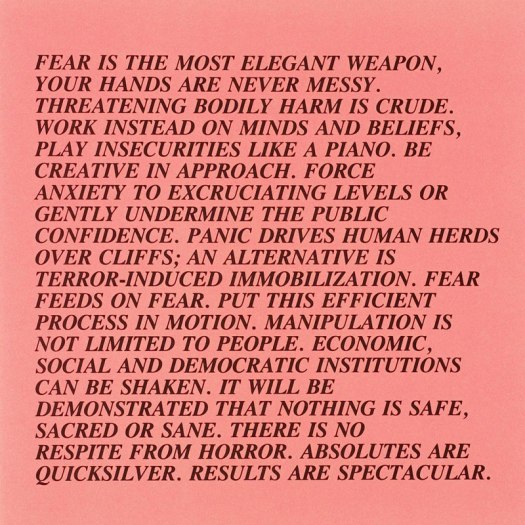
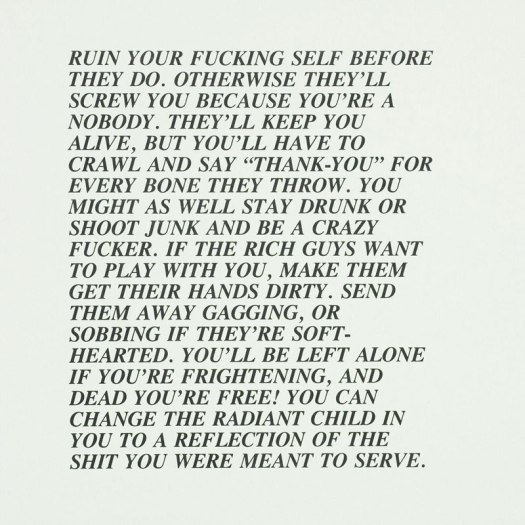
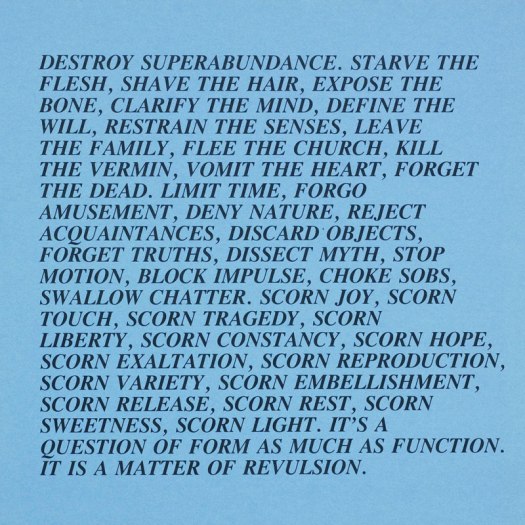
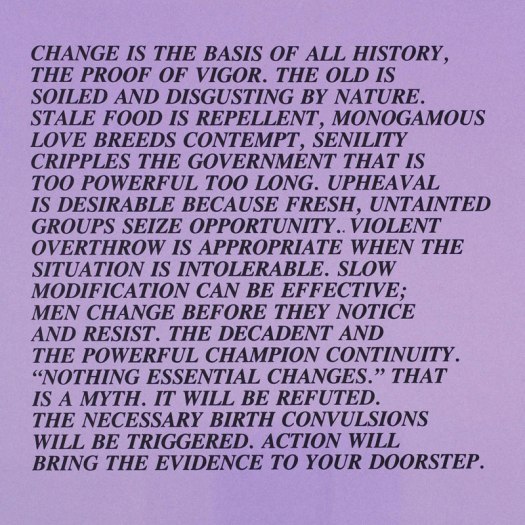
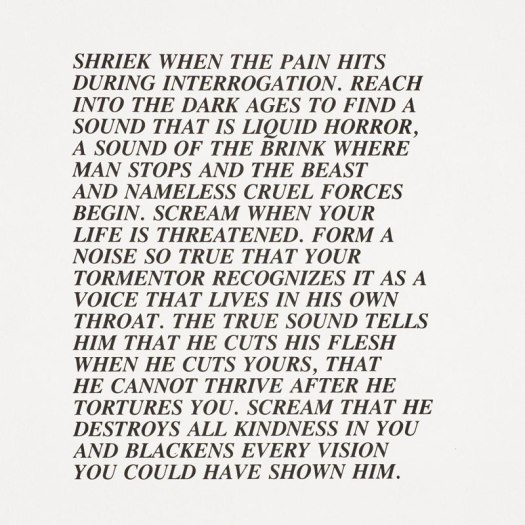
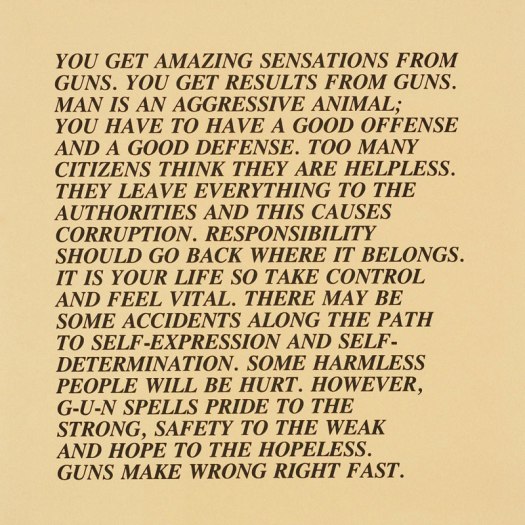
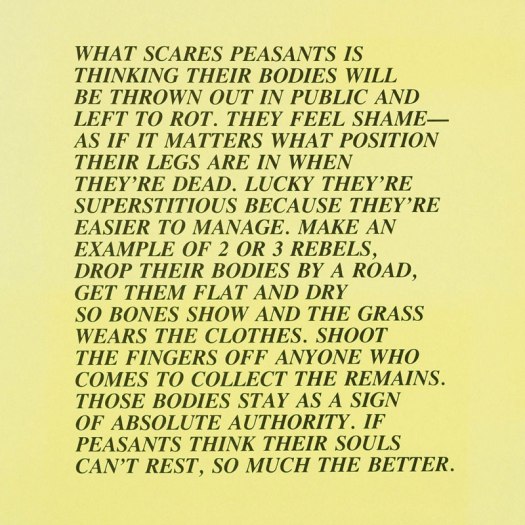
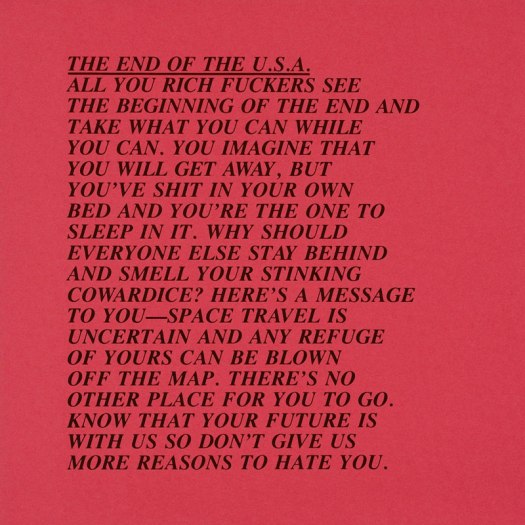
Tonight I revisited a brilliant series of text works by the great conceptual artist, Jenny Holzer. I won’t be able to do them justice, so I will let the work speak for itself.
Inflammatory Essays, 1979-1982
In a statement provided by the Holzer studio, the Inflammatory Essays are described as:
“a collection of 100-word texts that were printed on colored paper and posted throughout New York City. Like any manifesto, the voice in each essay urges and espouses a strong and particular ideology. By masking the author of the essays, Holzer allows the viewer to assess ideologies divorced from the personalities that propel them. With this series, Holzer invites the reader to consider the urgent necessity of social change, the possibility for manipulation of the public, and the conditions that attend revolution.”
There are others in addition to the ten pictured here, and I highly recommend examining more of Holzer’s work.
I love old things and I love quirky things. Old AND quirky is ideal.
Here in NYC, I occasionally go around and take shots of old and/or notable signage and storefronts. I guess you could say that it’s a hobby of mine. I really should do it more often; it helps me cope with the massive, decades-long wave of hyper-gentrification that continues to destroy everything I know and love.
I hope you like some of these shots. More, better quality ones to come (at some point)
*NOTE: A couple of these photos were taken in places other than New York City, and are captioned accordingly.
Lobster stand, Syracuse, NY. August 2016. (c) Gabrielle Lipner
Broadway Restaurant, New York, NY. July 2015. (c) Gabrielle Lipner
“The Attorney”, Cincinnati, Ohio. February 2015. (c) Gabrielle Lipner
Burger King at Vnukovo International Airport, Moscow, Russia. June 2015. (c) Gabrielle Lipner
Little Italy, New York, NY. December 2015. (c) Gabrielle Lipner
Murray’s Sturgeon Shop, New York, NY. July 2016. (c) Gabrielle Lipner
Skylight Diner, New York, NY. December 2015. (c) Gabrielle Lipner
Carnegie Deli (may it rest in peace), New York, NY. (c) Gabrielle Lipner
Flatbush Video, Brooklyn, NY. August 2016. (c) Gabrielle Lipner
Show World Center (what’s left of it). New York, NY. December 2015. (c) Gabrielle Lipner








 factorycandy